
Plan two full days in Samarkand to cover its core Silk Road monuments at a steady walking pace. Spend day one on Gur-e-Amir, Registan, Bibi-Khanum, and Siyob Bazaar, then day two on Shah-i-Zinda, Afrasiab, and Ulugh Beg Observatory. Add a third day for slower afternoons, market stops, and a second visit to Registan.
One, Two, or Three Days in Samarkand
UNESCO inscribed Samarkand – Crossroad of Cultures as a World Heritage property in 2001, recognizing the city as a major Silk Road intersection whose architecture peaked during the 14th- and 15th-century Timurid period.
| Stay length | Sights covered | Local transport | Best fit |
|---|---|---|---|
| 1 day | Gur-e-Amir, Registan, Bibi-Khanum, Siyob Bazaar, Shah-i-Zinda | Walk between central monuments; take a short taxi between the station and the old town | Tight rail stopover between Tashkent and Bukhara |
| 2 days | All central monuments plus Afrasiab archaeological site, Afrasiab Museum, and Ulugh Beg Observatory | Walk day one; combine walking with a short taxi or ride-hail to Ulugh Beg Observatory on day two | Independent travellers wanting every major monument at a steady pace |
| 3 days | Full two-day circuit plus a second visit to Registan, craft workshops, and unhurried market stops | Walk the old town; use taxis or ride-hailing for outer stops | Slower itineraries and unhurried afternoons |
Two full days give the cleanest balance. A single day compresses the central sights into a rapid march and drops Afrasiab and Ulugh Beg Observatory from the schedule. A third day adds space for midday rest, a second visit to Registan at a different hour, and extra time around Siyob Bazaar.
Practical Route Through Samarkand
Uzbekistan’s official tourism portal highlights Samarkand’s Timurid monuments alongside the older pre-Mongol settlement of Afrasiab. Grouping the six main stops across two days keeps each walking leg direct and avoids doubling back across the city.
1. Gur-e-Amir
Begin day one at Gur-e-Amir, the mausoleum of Amir Timur, his sons, and his grandson Ulugh Beg. Its ribbed turquoise dome rises above the brick courtyard and marks one of the defining forms of Timurid architecture, whose design later influenced Mughal monuments across South Asia. Step inside the main chamber to inspect the carved stone cenotaphs, dark jade marker, and gilded interior walls and ceiling.
2. Registan
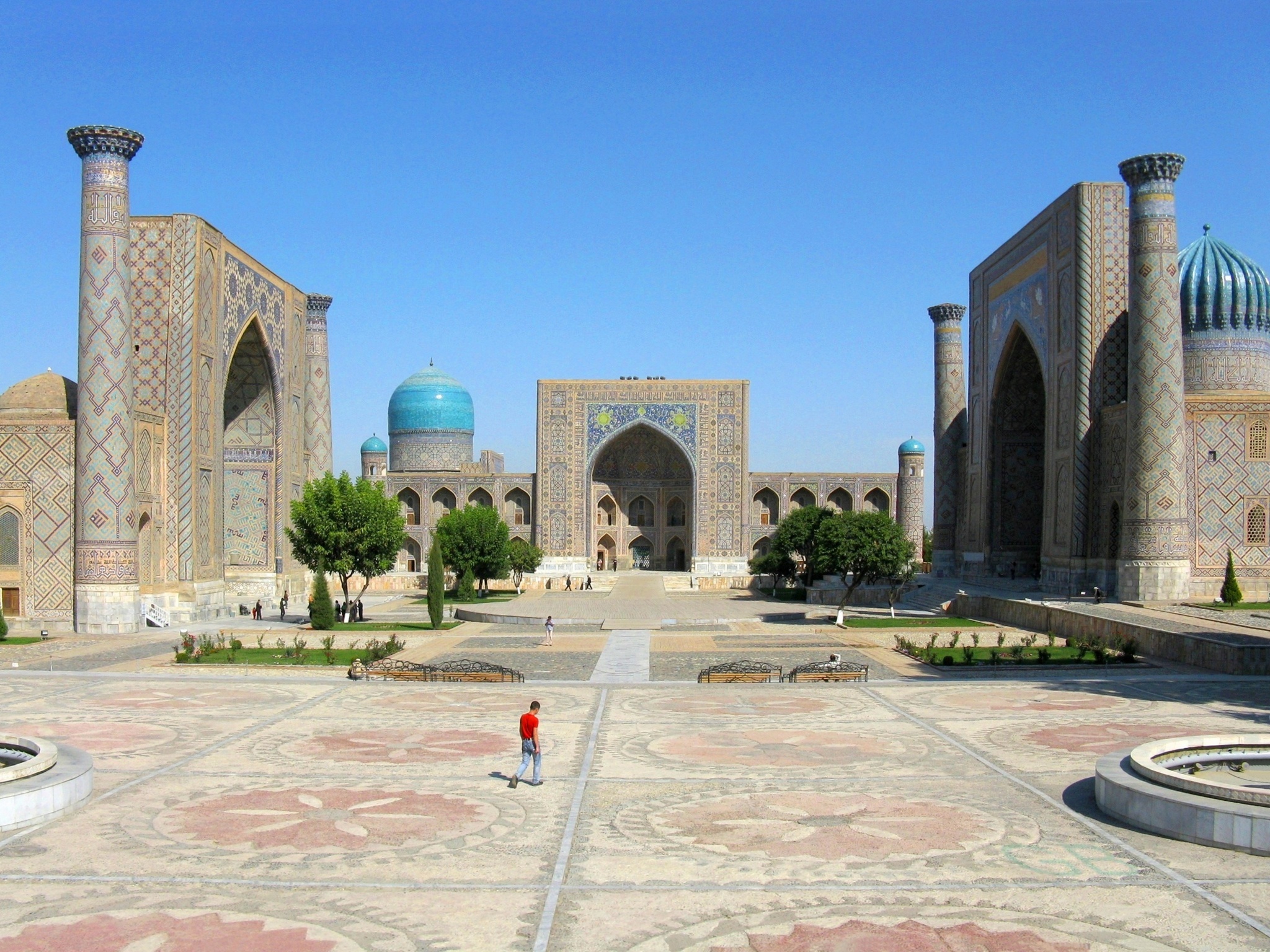
Walk from Gur-e-Amir to Registan, Samarkand’s central public square. Three monumental madrasas frame the open plaza on three sides:
- Ulugh Beg Madrasa (west): Built in the early 15th century with tall corner minarets and blue mosaic patterns across its entrance arch.
- Sher-Dor Madrasa (east): Recognizable for the tiled tiger and rising-sun motifs spanning the upper spandrels above the portal.
- Tilya-Kori Madrasa (north): Known for its interior mosque chamber, where blue and gold leaf cover the recessed ceiling and dome.
Enter all three courtyards to inspect the two-storey student cells and glazed tile details up close. Give Registan the largest share of your first morning, as each madrasa holds distinct brickwork, calligraphy, and courtyard proportions.
3. Bibi-Khanum Mosque and Siyob Bazaar
Continue on foot from Registan along Tashkent Street to Bibi-Khanum Mosque, commissioned by Amir Timur in the late 14th century as one of the largest mosques in the medieval Islamic world. Walk through the towering entrance portal into the open courtyard to see the oversized carved stone Quran lectern at its centre and the massive brick arches rising along the sides.
Exit Bibi-Khanum and step directly into Siyob Bazaar beside the mosque walls. Use the bazaar as your midday stop for fresh produce, snacks, and water before wrapping up day one or taking an afternoon break.
4. Shah-i-Zinda
Start day two early at Shah-i-Zinda, a hillside necropolis of mausoleums and shrines built around the tomb of Qutham ibn al-Abbas, a cousin of the Prophet Muhammad. The complex climbs a flight of steps along a narrow ceremonial lane lined with tombs from several centuries of Central Asian history. Glazed turquoise and cobalt panels line the narrow passages and doorways, combining carved terracotta, majolica, and geometric brickwork. Arriving early keeps the main staircase easier to navigate and gives clear light along the upper courtyards.
5. Afrasiab Archaeological Site and Museum
Continue north from Shah-i-Zinda to the earthen hills of Afrasiab, the oldest part of Samarkand, founded in the 7th century BC. The exposed mounds mark the footprint of the pre-Mongol city destroyed in the 13th century, before Timurid builders established the monumental centre to the south. Visit the Afrasiab Museum at the edge of the archaeological reserve to view excavated artifacts and the preserved 7th-century pre-Islamic Sogdian wall paintings.
6. Ulugh Beg Observatory
Finish day two with a short taxi or ride-hail from the Afrasiab Museum to Ulugh Beg Observatory. Built in the 1420s by the astronomer-ruler Ulugh Beg, the circular observatory was one of the leading scientific centres of the medieval Islamic world. Today, the site preserves the sunken, marble-faced meridian arc cut deep into the bedrock, which astronomers used to measure celestial positions, map more than 1,000 stars, and calculate the length of the stellar year. Walk down into the shaded trench to view the curved marble rails, then visit the adjacent museum building for historical context on Ulugh Beg’s star catalogue.
Arrival, Entry Rules, and Local Transport
Entry Requirements
Entry details were checked on 2026-11-27 against official government sources:
- Visa-free entry: According to UK government travel advice, many visitors can enter Uzbekistan visa-free for up to 30 days.
- Electronic visas: Travellers requiring a tourist visa apply through Uzbekistan’s official e-visa portal at e-visa.gov.uz, confirmed via Uzbekistan’s digital government portal.
- Passport validity: Government of Canada travel advice advises travelling with a passport valid for at least six months.
Entry eligibility and passport rules vary by nationality, so check the official source for your passport before booking transport.
Arriving by Train or Flight
- By rail: Uzbekistan Railways connects Samarkand Railway Station directly with Tashkent and Bukhara on both high-speed Afrosiyob trains and conventional services. Reserve seats ahead of time through the official Uzbekistan Railways ticket portal.
- By air: Samarkand is also reachable by air via its airport, connecting the city with domestic and international routes.
Local Transport
Walk between Gur-e-Amir, Registan, Bibi-Khanum, Siyob Bazaar, Shah-i-Zinda, and the Afrasiab Museum. Staying near the central monuments lets you cover most of the two-day route on foot and limits cross-town transfers.
Use a ride-hailing app such as Yandex Go or a local taxi for transfers from the railway station, the airport, and the final leg out to Ulugh Beg Observatory. When hailing a street taxi outside the station or bazaar, agree on the exact fare and destination before climbing in.
Respectful-Visiting Checklist
Uzbekistan’s official tourism guide asks visitors to dress respectfully at religious sites. Follow these habits across Samarkand’s mosques, madrasas, and mausoleums:
- Cover shoulders and knees: Choose loose trousers or a long skirt and a sleeved shirt when visiting mosques, madrasas, and mausoleums.
- Carry a light scarf: Keep a thin scarf in your daypack for extra shoulder or head coverage at religious monuments.
- Follow posted doorway signs: Check local signs at entrances to prayer rooms or tomb chambers and follow instructions from site caretakers.
- Lower your voice: Keep conversation quiet inside Shah-i-Zinda and Gur-e-Amir, silence phone alerts, and give local visitors space.
- Ask before photographing people: Request clear permission before pointing a camera at worshippers, site caretakers, or market vendors.
- Keep hands off historic surfaces: Observe tilework, carved doors, and plasterwork from the designated walkways and keep hands and bags clear of the walls.
Frequently Asked Questions
How many days do you need in Samarkand?
Two full days cover Gur-e-Amir, Registan, Bibi-Khanum, Siyob Bazaar, Shah-i-Zinda, Afrasiab, and Ulugh Beg Observatory at a steady pace. Add a third day for slower afternoons, a return visit to Registan, and extra time at local markets and craft workshops.
Can you walk between the main sights in Samarkand?
Yes. Gur-e-Amir, Registan, Bibi-Khanum, Siyob Bazaar, Shah-i-Zinda, and the Afrasiab Museum can all be linked on foot. Take a short taxi or ride-hail for Ulugh Beg Observatory and transfers to the railway station or airport.
Do you need a visa to visit Samarkand?
Uzbekistan offers 30-day visa-free entry as well as online tourist visas through e-visa.gov.uz. Use the official government links in the entry requirements section above before finalizing travel dates.
When is the best time of year to visit Samarkand?
Spring (April to May) and autumn (September to November) offer the mildest daytime temperatures for walking between open courtyards and archaeological mounds.
What should travellers wear at Samarkand mosques and mausoleums?
Wear modest, breathable clothing that covers your shoulders and knees, plus comfortable walking shoes for stone courtyards and stairs. Carry a lightweight scarf in your daypack so you can dress respectfully at every religious site.
Next Step
Once your Samarkand route is set, fit the city into a wider itinerary. Browse our underrated travel destinations for quieter stops that pair well with Central Asia, compare broader options in our guide to cheap places to travel, or open the full destinations index to map your next independent trip.
Featured photo: Registan Square, Samarkand, by Euyasik, CC BY-SA 3.0, via Wikimedia Commons.