
Antigua Guatemala is a 16th-century colonial city in Guatemala’s central highlands, inscribed as a UNESCO World Heritage Site in 1979 for its preserved Renaissance street grid and Baroque ruins. This guide suits first-time visitors planning a one- or two-day heritage stay, or pairing the historic centre with a wider Guatemala route.
Choose Your Trip Length in Antigua Guatemala
Plan two full days for a first visit. That window covers the core street grid, key convent ruins, one or two museums, and a stop at Cerro de la Cruz.
| Trip Type | Who It Suits | Core Focus | Planning Trade-Offs |
|---|---|---|---|
| One-day visit | Tight-schedule travellers passing through central Guatemala | Plaza Mayor, San José Cathedral, 5th Avenue North, Santa Catalina Arch, and one ruin | Covers exterior architecture and one monument cluster; leaves museums for another trip |
| Two-day visit | First-time visitors wanting a balanced historic-city stay | Core grid and arch on day one; convent ruins, a museum, and Cerro de la Cruz on day two | Pairs Plaza Mayor and the arch on day one with convent ruins and a museum on day two |
| Heritage-focused trip | Architecture and history readers planning three or more days | Convent ruins, MUNAG, Museum of Colonial Art, Museum of Old Books, and Holy Week Museum | Supports slower study of Baroque ruins, museums, and conservation history |
| Wider Guatemala route | Multi-stop travellers combining Antigua with other regions | Antigua as a two-day heritage base inside a regional itinerary | Requires building transfer days and border rules into the wider schedule |
Trip costs shift mostly with four choices: travel dates, stay length, regional transport, and how often you pair local sweet shops or bakeries with full sit-down meals. Travellers comparing regional budgets across Central and South America can pair this stop with our guides to cheap Latin American countries and cheap places to travel.
Inside the Historic Centre
Antigua Guatemala sits in the department of Sacatepéquez at 1,500 metres above sea level in a seismic zone of Guatemala’s central highlands. Spanish colonists founded the city in the early 16th century as the capital of the Captaincy-General of Guatemala.
Urban planners laid out the historic core on a checkerboard street grid (trazado en damero) based on Italian Renaissance principles. That orderly layout makes orientation simple on foot, with cobblestone streets (calles empedradas), colourful colonial façades, and interior patios.
Plaza Mayor anchors the centre alongside San José Cathedral, giving first-time visitors a clear starting point before exploring the surrounding blocks.
Churches, Monasteries, Ruins, and Museums
Antigua’s open-air ruins stem directly from its seismic history. After the destructive Santa Marta earthquakes of 1773, colonial authorities relocated the capital to present-day Guatemala City, and much of the population moved away from 1776 onward. Major Baroque churches, convents, and monasteries remained standing as monumental ruins.
Visit Guatemala highlights several core religious sites across the grid:
- San José Cathedral: Positioned on Plaza Mayor.
- Santa Clara and San José el Viejo: Convent and church ruins featured on the official tourism route.
- La Merced Church: A prominent colonial church within the historic core.
Official tourism listings also feature several indoor museums: MUNAG (National Museum of Art of Guatemala), Casa Santo Domingo, the Museum of Colonial Art, the Museum of Old Books, and the Holy Week Museum (Museo de Semana Santa).
Between visits, look for traditional sweets (dulces típicos): milk sweets (canillitas de leche), coconut sweets (cocadas), candied figs and oranges, tamarind treats, and nuégados.
Visiting the Santa Catalina Arch
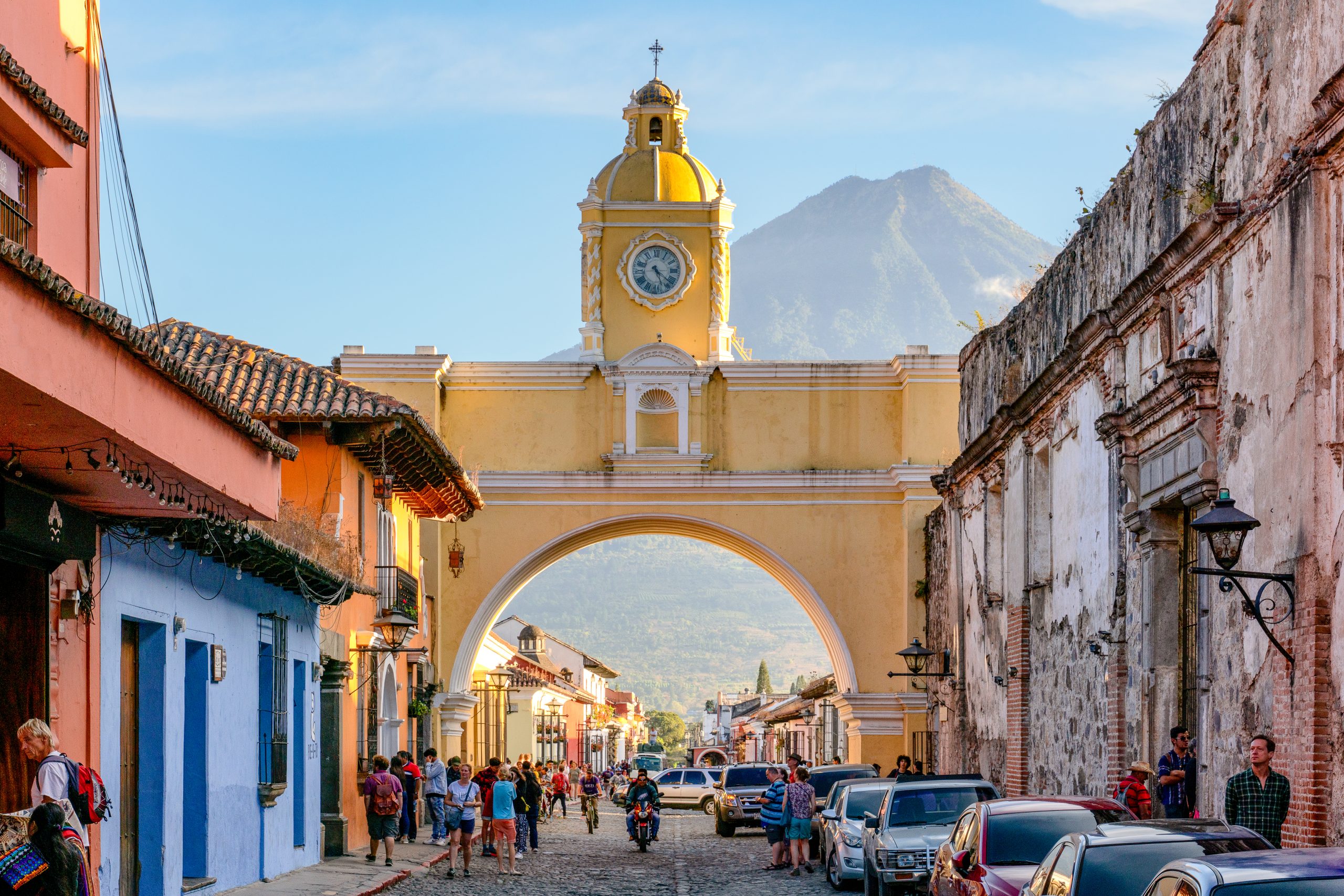
The Santa Catalina Arch (Arco de Santa Catalina) spans 5th Avenue North (5a Avenida Norte). Builders constructed the arch in 1693 to connect the Convent of Santa Catalina across the street so cloistered nuns could pass between buildings out of public view.
Because 5th Avenue North remains an active street lined with doorways and shops, step onto the pavement edge while setting up photographs so pedestrians and vehicles move freely.
Conservation and Respectful Photography
UNESCO inscribed Antigua Guatemala in 1979 as property 65 under criteria (ii), (iii), and (iv), recognising its Renaissance urban plan, colonial architecture, and preserved ruins. Formal domestic protection began in 1944, when Guatemala declared the city a national monument.
UNESCO conservation records list ongoing pressures from earthquakes, volcanic eruptions, hurricanes, rising vehicular traffic, gentrification, illegal construction, tourism volume, and adaptive reuse inside historic structures such as hotel development within the Santo Domingo ruins.
Visitors help protect the city through simple habits:
- Stay on marked paths inside ruins and keep off fragile stone walls, arches, and stucco surfaces.
- Keep voices low, silence phones, and follow posted photography rules inside active churches.
- Ask permission before photographing residents, market vendors, or religious observances.
- Wear supportive, closed-toe footwear for uneven cobblestones and stone steps.
A Flexible Two-Day Example Itinerary
Treat this outline as a flexible example. Verify site hours, ticket windows, and restoration closures locally on arrival, as conservation work and religious services adjust access.
Day 1: Plaza Mayor, 5th Avenue North, and La Merced
Start at Plaza Mayor to orient yourself inside the 16th-century grid and visit San José Cathedral. Include 5th Avenue North for the Santa Catalina Arch, plus La Merced Church. Spend the afternoon exploring colonial courtyards and sampling dulces típicos such as canillitas de leche or cocadas.
Day 2: Convent Ruins, Museums, and Cerro de la Cruz
Spend the morning at one or two ruin complexes highlighted by Visit Guatemala, such as Santa Clara and San José el Viejo. Follow with an indoor museum: MUNAG, the Museum of Colonial Art, the Museum of Old Books, the Holy Week Museum, or Casa Santo Domingo. Visit the Cerro de la Cruz viewpoint to finish the day.
Leave buffer time for local calendar events and conservation work that may change access.
Entry Requirements and Border Checks
Entry rules below were checked in November 2026; confirm current requirements with your government and Guatemalan migration authorities before travel.
Under Guatemala’s Reglamento de Visas Guatemaltecas (Acuerdo AMN 007-2023 framework administered by the Instituto Guatemalteco de Migración, IGM), foreign nationalities fall into three visa categories:
- Category A: Visa-exempt.
- Category B: Consular visa required.
- Category C: Consulted visa required, needing prior central authorisation from IGM.
Check your passport’s exact category directly with IGM or a Guatemalan consulate, because visa exemptions apply by nationality.
UK passport holders (UK FCDO guidance): Full British citizen passports need at least 6 months’ validity after arrival and 2 blank pages. British citizens visit for up to 90 days visa-free; overstaying incurs a fine. Get an arrival passport stamp and complete the online immigration declaration before arrival and departure.
Canadian passport holders and CA-4 rules (Travel.gc.ca guidance): Regular Canadian passports need at least 6 months’ validity beyond expected departure. Under the Central America-4 (CA-4) agreement with El Salvador, Honduras, and Nicaragua, travellers share a combined 90-day authorised tourist stay, extendable through IGM to 180 days. Obtain border entry and exit stamps and submit the electronic declaration before arrival and departure. Canadian guidance also advises holders of “X” gender passports to confirm entry or transit rules with foreign representatives beforehand.
Travellers holding other passports must verify rules with their own national authority and IGM. Remote workers planning extended stays beyond short-term tourist limits can review dedicated long-stay pathways in our guide to digital nomad visa countries.
Frequently Asked Questions
Where is Antigua Guatemala?
Antigua Guatemala sits in the department of Sacatepéquez in Guatemala’s central highlands. It is the historic city at the centre of this guide’s heritage itinerary.
How many days should you spend in Antigua Guatemala?
Two full days suit most first-time visitors, covering Plaza Mayor, the Santa Catalina Arch, key convent ruins, a museum, and Cerro de la Cruz. One day covers the core streets; three days suit museum-focused trips.
What is Antigua Guatemala known for?
Antigua Guatemala is known for its 16th-century Renaissance street grid, cobblestone streets, colonial façades, Baroque church and monastery ruins from the 1773 earthquakes, the Santa Catalina Arch, and dulces típicos.
Is Antigua Guatemala a UNESCO World Heritage Site?
Yes. UNESCO inscribed Antigua Guatemala in 1979 as property 65 under criteria (ii), (iii), and (iv), recognising its colonial urban plan, architecture, and preserved ruins.
What are the entry requirements for Antigua Guatemala?
Entry rules depend on nationality under Guatemala’s Category A, B, and C visa system. UK guidance for British citizen passports notes six months’ validity after arrival, two blank pages, 90 days visa-free, entry stamps, and an online declaration before arrival and departure. Check your own government’s advice and Guatemalan migration rules before travel.
Official Sources
- Visit Guatemala: Antigua Guatemala
- UNESCO World Heritage Centre: Antigua Guatemala (Property 65)
- UK Foreign Travel Advice: Guatemala Entry Requirements
- Instituto Guatemalteco de Migración: Reglamento de Visas Guatemaltecas (007-2023)
- Government of Canada: Guatemala Travel Advice
Featured photo: Santa Catalina Arch, Antigua Guatemala, by Chad Davis, CC BY-SA 2.0, via Wikimedia Commons.